Additional Visuals:
Development of The Deaf Reading Rope Model
The Deaf Reading Rope grew out of a desire to combine the general theories and approaches to reading with the unique and specific approaches and research for deaf and hard of hearing students, especially those that use sign language as their primary language of learning. Dr. Harrison was an adjunct faculty member teaching instructional strategies for ASL/English and felt frustrated at the lack of clear visuals for Deaf literacy that incorporated all the excellent research that has been done in Deaf Education. Over the course of the next two years, he performed a meta-analysis and combined the frameworks of the Science of Reading with the themes and best practices of Deaf literacy research. The result was the Deaf Reading Rope model and subsequent workbook.
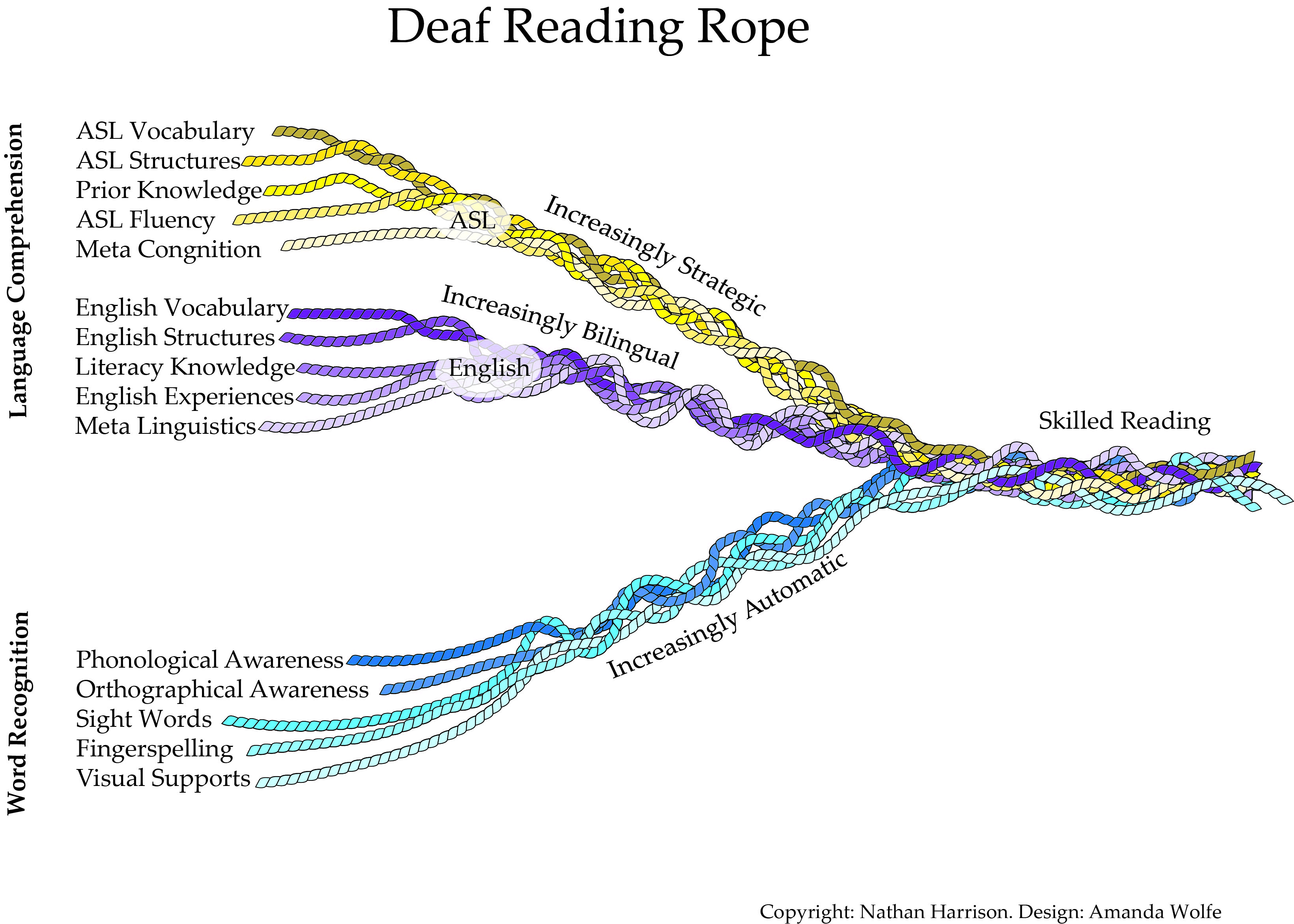
The model combines the Science of Reading with the best practices of Deaf research into literacy. The rope modeled, patterned after Scarborough’s Reading Rope, visually demonstrates that reading is made up of a wide variety of small strands (practices and skills) that braid together to create skilled, fluent reading.
The goal of the Deaf Reading Rope isn’t to be a curriculum, checklist, or to-do list – rather, the Deaf Reading Rope is meant to be a way of thinking that encourages teachers and schools to consider what they are already doing, what they could improve, and what they have overlooked.
In 2026, while collaborating with Ko Taku Reo: Deaf Education New Zealand, Dr. Harrison began the process of creating an updated version of the model, especially one that can address the international Deaf Education audience. More coming on this.
Read more about the development of the Deaf Reading Rope: https://osf.io/d96jx/wiki?wiki=xv9r2
The 2023 Deaf Reading Rope
Workbook:
https://osf.io/d96jx/files/xjs7g